

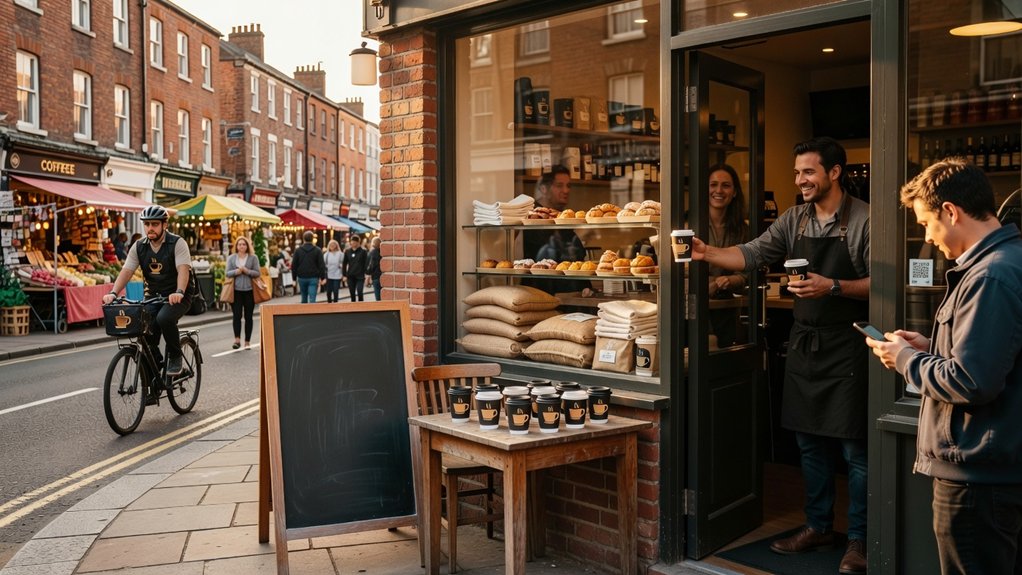
You’ll promote a small UK business fastest by setting a measurable local goal (like 30 enquiries a month) and building a budget from conversion rate, order value, and margin. Claim and optimise your Google Business Profile, keep NAP consistent, add geo-tagged photos, and collect location-specific reviews to win “near me” searches. Pick 1–2 social channels your locals use, post proof and offers weekly, and use segmented email to drive repeats. Keep ads small, postcode-targeted, and tracked with GA4 and UTMs. Keep going to see how to benchmark competitors and fine-tune spend.
Key Takeaways
- Set a UK-specific goal and reverse-calculate a realistic budget using conversion rate, average order value, and profit margin.
- Maximise local visibility with a fully optimised Google Business Profile and consistent NAP across your website and directories.
- Build local SEO pages and links targeting your service areas, using maps, schema markup, and location-specific testimonials.
- Focus on 1–2 social platforms your local customers use, posting proof, offers, and behind-the-scenes content three times weekly.
- Run low-budget, tightly targeted Google and Meta ads by postcode, track conversions with GA4/UTMs, and optimise weekly for CPA and ROAS.
Set Your UK Promotion Goals and Budget (Fast)

Before you spend a pound on ads, print, or partnerships, set one clear UK-specific goal (for example, 30 new enquiries a month in Greater Manchester or £5k in online sales nationwide) and attach a number and deadline to it. Don’t throw money on marketing, until you know what areas to aim for.
Then build a budget backwards: estimate your conversion rate, average order value, and margin, and cap spend so customer acquisition stays profitable.
Use Market research to confirm demand by region and channel—Google Trends, ONS data, and your own sales history help you size the prize. Hire a SEO freelance consultant who knows this inside and out. It will cost you money, but it’s well worth the small investment.
Run Competitor analysis to benchmark typical UK CPCs, offer pricing, and messaging, so you don’t underfund or overspend.
Finally, split spend 70/20/10: proven channels, experiments, and always-on measurement and tracking.
Review weekly, adjust fast.
Win Local Searches With Google Business Profile + Local SEO
If you rely on nearby customers, Google Business Profile (GBP) and local SEO usually deliver the highest-intent leads in the UK because they put you directly in the “near me” results and Google Maps pack.
Claim and verify GBP, then lock your NAP (name, address, phone) to match your website and directories. Pick precise categories, add services, pricing, and 10–20 geo-tagged photos. Post offers weekly and answer Q&As fast.
Collect Customer testimonials and reply to every review using location terms naturally (e.g., “in Leeds city centre”). Build location pages with embedded maps, local schema, and consistent opening hours.
Earn local links via Local partnerships with chambers, schools, and nearby suppliers. Track calls, directions, and bookings in GBP Insights, then refine keywords and pages monthly.
Choose 1–2 Social Channels Your Local Customers Use
Google Business Profile gets you found at the moment of intent; social media keeps you visible in the weeks between searches and turns locals into repeat buyers.
Pick just one or two channels your customers already scroll: Instagram and TikTok for food, beauty, fitness; Facebook for community services and over-35s; LinkedIn for B2B; Nextdoor for neighbourhood trades.
Validate your choice with UK signals: check where competitors get comments, review your own tagged photos, and run £20 geo-targeted tests within 5–10 miles to compare cost per message.
Post three times weekly: one local proof (before/after), one offer, one behind-the-scenes.
Use Influencer collaborations with micro-creators in your postcode, and run Social media contests that require local pickup to filter real prospects.
Use Email Offers to Bring UK Customers Back
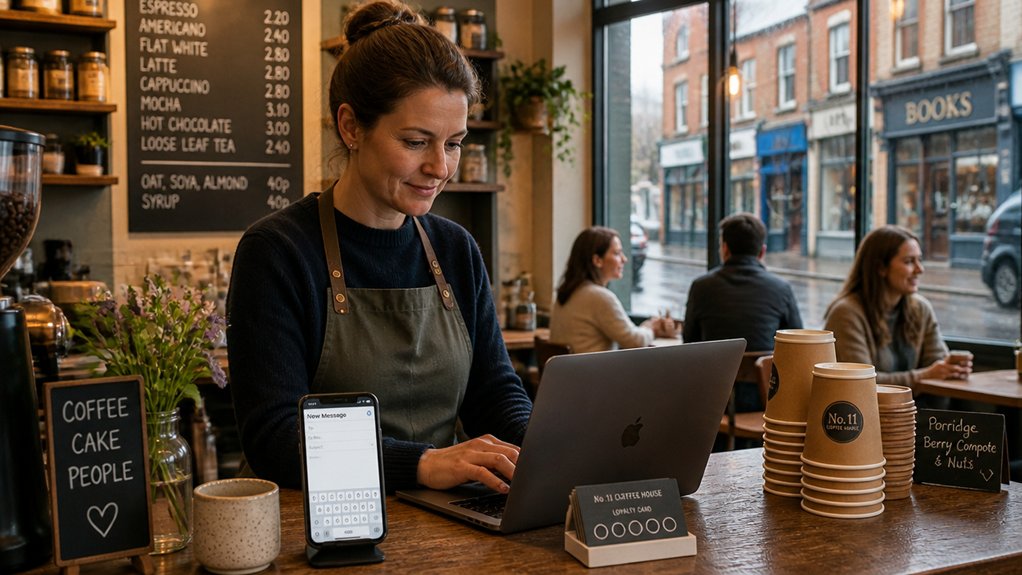
Although social feeds move fast, email still gives you the cheapest, most predictable way to bring UK customers back—because you control the audience and can time offers around real buying patterns.
Start with Email segmentation: split lists by postcode, last purchase date, average order value, and category interest.
Then send targeted offers like “free UK delivery over £35” to lapsed buyers, or “bundle and save” to high-frequency customers.
Aim for one clear CTA and a time limit aligned with paydays (end-of-month and the 15th) or seasonal spikes (Bank Holidays, Back to School).
Track open rate, click rate, and revenue per email, not vanity followers.
Use a simple points or VIP tier to grow Customer loyalty and reduce churn.
Automate win-back and replenishment sequences.
Run Low-Budget UK Ads With Clear Targeting and Tracking
When you run UK ads on a tight budget, you win by narrowing the audience and measuring every pound back to revenue. Start with postcode targeting around your service area, then layer interests and intent (e.g., “same-day delivery”, “near me”) on Meta and Google.
Keep budgets small, but split tests: two headlines, two images, one offer, and rotate Creative content weekly.
Set up GA4, pixels, and conversion events (calls, forms, purchases), then tag every campaign with UTM codes. Track CPA and ROAS by channel, not clicks.
Use dayparting to focus spend on peak UK hours, and exclude past converters to stop waste. If you’ve got social proof, trial Influencer partnerships with tracked links and discount codes so you can compare their CPA against ads.
Conclusion
If you treat UK promotion like a weekly shop, you’ll stop overspending and start buying what works. One Leeds café owner I met put £50 into a Google Business Profile refresh and local SEO, then tracked calls and direction requests; within a month, walk-ins rose 18%. You can do the same: set a tight goal and budget, pick 1–2 social channels your locals actually use, send email offers, and run small, measurable ads.