

Over 70% of employers screen candidates online before making a hiring decision. If your profiles don’t match, you’re forcing people to guess what you stand for, and they won’t guess in your favor. You can control the signal by aligning your name, headshot, bio, and proof points across platforms, then removing content that creates doubt. The fastest credibility wins aren’t where you think they are—start with what shows up first when someone searches you…
Key Takeaways
- Audit your search results quarterly in incognito across devices, logging top mentions’ titles, sources, dates, and sentiment to spot reputation shifts.
- Define 2–3 brand signals and back them with proof points like measurable outcomes, certifications, portfolio links, testimonials, or press mentions.
- Standardize your identity everywhere: consistent name spelling, role titles, headshot style, and a concise bio that states value and credibility.
- Clean up outdated or risky content by tightening privacy, unlisting legacy profiles, requesting takedowns, and replacing gaps with updated, optimized profiles.
- Build credibility through consistent posting, pinned best work, thoughtful comments, prompt responses, and alerts that notify you of new mentions.
Audit Your Online Image by Searching Your Name

Before you update your profiles or publish new content, run a quick audit by searching your name the way a recruiter or client would. Use incognito mode, try multiple browsers, and test variations (full name, nickname, city, employer).
Review the first two pages of results, since most users don’t go further, and capture screenshots for comparison later.
Then map what you find to action: outdated bios, broken links, inconsistent titles, and unflattering images. Note any Privacy concerns, such as exposed phone numbers, addresses, or old documents, and request removals where possible.
Check social profiles for public posts that rank highly. Finally, assess Search engine optimization basics: do your best assets appear first, and do key pages use consistent naming, headlines, and metadata?
Decide What Your Professional Online Image Should Signal
Although your search audit shows what the internet currently says about you, you still need to decide what you want it to communicate.
Start by defining 2–3 signals you want employers and clients to remember, such as technical depth, leadership, or reliability. Then translate each signal into proof points: measurable outcomes, certifications, portfolio artifacts, publications, or testimonials.
Align your channels to reinforce those proof points with branding consistency—use the same role title, summary themes, and core skills across LinkedIn, your website, and industry profiles.
Treat your digital footprint like a funnel: top results should answer who you are, what you do, and the value you deliver in under 10 seconds.
Finally, set a review cadence and track visibility metrics like search rankings and profile views.
Remove, Hide, or Replace Unprofessional Content
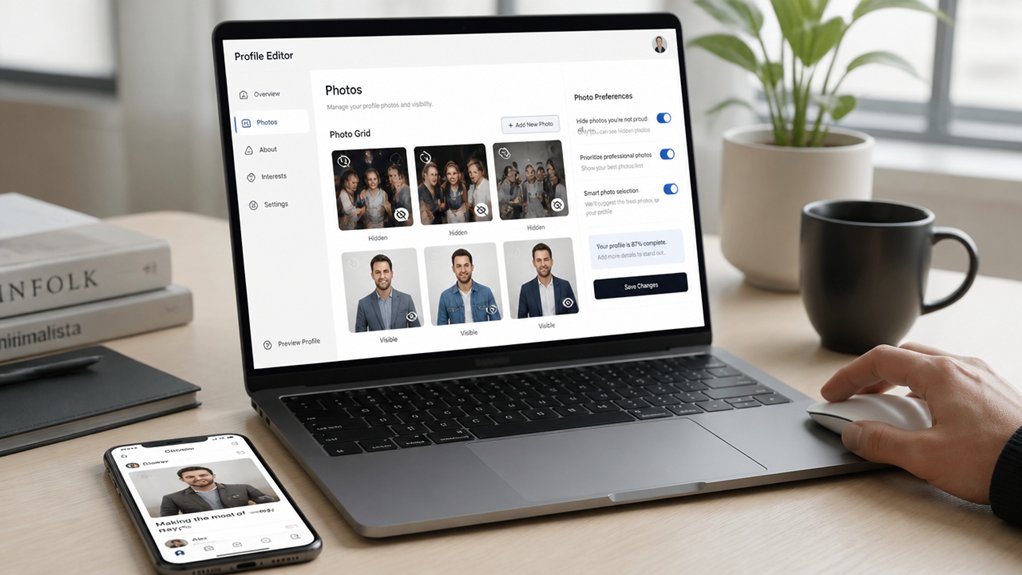
Where do you start when your search results surface content that undermines credibility? Begin with an audit: search your name in incognito, check image results, and list the top links driving impressions. Prioritize items tied to your full name, employer, or location, since those rank and spread faster.
Next, act in tiers. First, pursue content removal: delete old posts, request takedowns from site owners, and use platform reporting tools when policies support you.
Second, tighten privacy settings on legacy accounts and photo tags, and unlist outdated profiles where possible.
Third, replace what you can’t remove by publishing updated bios, portfolio pages, and recent work that earns backlinks. Recheck monthly; most reputational shifts track to the first 10 results.
Make Your Social Profiles Employer- and Client-Ready
A strong social profile acts like a live résumé—often one of the first assets employers and clients scan to validate credibility. Treat each platform as a portfolio: highlight outcomes, showcase current projects, and pin your best work so it’s immediately visible. Use Visual branding to signal professionalism at a glance, and keep layouts clean and readable across devices.
Prioritize Content consistency: align your topics, tone, and posting cadence with the roles or clients you want, and remove off-message debates that dilute expertise.
Strengthen trust with proof—case metrics, testimonials, press mentions, or certifications—and link to work samples that demonstrate impact.
Audit privacy and tagging settings, and enable two-factor authentication to reduce risk.
Finally, monitor comments and messages, respond promptly, and keep every interaction respectful and business-ready.
Standardize Your Name, Photo, Bio, and Links

Three profile elements—your name, photo, and bio—do most of the credibility work before anyone reads your posts. Standardize them across platforms so people can verify you fast and avoid confusion.
Use Name consistency: pick one spelling, spacing, and credential format (e.g., “Jane Q. Lee, PMP”) and keep it identical on LinkedIn, X, email, and portfolios.
Choose a professional headshot with consistent lighting and framing; profiles with clear faces earn higher recognition and faster trust in quick scans.
Write a tight bio that states role, value, and proof (metrics, industries, certifications) in 2–3 lines.
Finally, consolidate links: use one primary URL, a clean link hub if needed, and remove outdated sites.
This Profile branding reduces friction and improves searchability.
Pick 2–3 Topics Your Personal Brand Is About
Two or three clear topics should anchor your personal brand, because audiences and algorithms both categorize you faster when your content clusters around consistent themes.
Pick topics that overlap your expertise, your target audience’s needs, and the roles you want next. Use proof points: projects you’ve shipped, problems you’ve solved, and metrics you can defend.
Pressure-test your choices with search behavior and platform signals: review recurring questions in your inbox, job descriptions you’re targeting, and the keywords people use to find peers like you.
Aim for one core specialty, one adjacent capability, and one values-driven lens (like ethics, accessibility, or leadership). This focus reduces mixed signals, strengthens personal branding, and protects your digital reputation by making your intent and competence easy to interpret.
Post a Simple Content Mix That Builds Credibility
To build credibility fast, you’ll want a simple content mix that shows both how you think and what you’ve done.
Post thought leadership that shares clear, measurable insights from your work (e.g., lessons learned, trends you’re tracking, results you’re seeing).
Then support it with proof and portfolio content—case studies, metrics, screenshots, and testimonials—so people can verify your claims in seconds.
Thought Leadership Posts
How do you build credibility online without posting nonstop or sounding self-promotional?
Publish thought leadership posts that translate your experience into clear, reusable frameworks. Aim for one strong idea per post: a trend you’ve validated, a decision checklist, or a “what I’d do differently” lesson tied to outcomes.
Use Brand consistency by repeating your core themes, terms, and point of view, so readers know what you stand for in seconds. Support claims with lightweight data: benchmarks, before/after metrics, or reputable industry stats with links.
Practice Content curation by summarizing a high-quality report and adding your implications, not just a quote. Keep posts scannable—headline, 3–5 bullets, takeaway.
Invite discussion with one specific question to peers.
Proof And Portfolio Content
Thought leadership earns attention, but proof and portfolio content earns trust because it shows what you’ve actually delivered. Build a content portfolio that includes 2–3 case studies, before/after metrics, and a short walkthrough of your process.
Use clear numbers (time saved, revenue impact, error reduction) and state your role, tools, and scope to prevent ambiguity.
Add credential verification where it matters: link to licenses, certifications, publications, or client references, and keep dates current.
Post one proof asset weekly—screenshot, dashboard snippet, testimonial quote, or project recap—then pin your best examples.
Keep everything scannable: headlines, bullets, and a single takeaway.
When you pair outcomes with verifiable credentials, you reduce buyer risk and speed decisions, consistently over time.
Comment, DM, and Network Like a Professional
While your profile and posts set the stage, your comments, DMs, and networking habits determine whether people trust you enough to respond.
Treat every interaction like a micro-sample of your work: clear, respectful, and on-time. Use Effective communication by adding one insight, one question, or one resource—skip vague praise.
Keep comments specific to the thread and cite data or results when relevant.
In DMs, lead with context and value: who you are, why you’re reaching out, and a concrete ask that takes under 30 seconds to answer.
Personalize with a shared interest or recent post, then propose one next step.
For Relationship building, follow up once, thank people, and share credit publicly.
Track key contacts and nurture them with occasional, relevant updates.
Set Alerts and Review Your Online Image Quarterly
Set up reputation-monitoring alerts (e.g., your name, company, and key projects) so you’re notified quickly when new mentions appear.
Then audit your first-page search results every quarter and track changes in what ranks, what’s outdated, and what’s missing.
Use those findings to update profiles, correct inaccurate mentions, and reinforce the content that best supports your professional goals.
Configure Reputation Monitoring Alerts
If you don’t know what’s being said about you online, you can’t manage it effectively. Configure reputation alerts so you’re notified within minutes, not weeks, when your name, company, or key projects are mentioned.
Start with Google Alerts, then add social listening tools (LinkedIn, X, Reddit) if your role is public-facing. Use precise queries: your full name in quotes, common misspellings, employer name plus your title, and product or campaign names.
Set alert frequency to “as-it-happens” for high-risk terms and daily digests for low-risk terms. Route alerts to a dedicated inbox and tag them by source and sentiment.
This online monitoring workflow reduces response time and helps you spot patterns early. Review settings monthly to cut noise.
Audit Search Results Quarterly
Because search results shift faster than most people notice, you should run a quarterly audit of what appears when someone Googles your name, company, and key projects—then compare it against your intended professional narrative.
Use an incognito window, check top 2–3 pages, and repeat on mobile and desktop to capture real-world variance.
Log each result’s title, source, date, and sentiment, then flag anything that weakens brand consistency or introduces confusion about your role.
Track share of positive, neutral, and negative mentions over time so you can spot trends, not anecdotes.
Review image and video tabs, “People also ask,” and knowledge panels, since they shape first impressions quickly.
This cadence keeps your digital reputation measurable, current, and defensible.
Update Profiles And Mentions
Within 24 hours of spotting a mismatch in your quarterly audit, update the profiles and mentions you control (LinkedIn, company bio, portfolio, speaker pages) and request corrections where you don’t.
Prioritize fields recruiters and clients scan first: headline, role dates, location, specialties, and contact links. Keep Profile updates consistent across platforms to reduce confusion and improve match rates in search results.
Set Google Alerts for your name, company, and key credentials so you catch new citations within days, not months.
For mention management, log each correction request with the URL, the exact text to change, and a follow-up date. If a site won’t edit, publish an updated source page you control and reference it in future outreach.
Repeat quarterly.
Conclusion
Your professional online image isn’t a one-time project; it’s an asset you manage. If you think you don’t have time, remember: employers and clients routinely screen candidates online, and inconsistent profiles can reduce trust fast. You can start small—standardize your name, photo, bio, and links, then share insights on 2–3 topics that prove expertise. Set alerts and run a quarterly review to keep outdated content from undermining credibility.