


Do you struggle for content marketing ideas? Pick one outcome you want more of—calls, bookings, or sales—then build everything around it. Spend 30 minutes a week: review what drove enquiries, draft three short posts (proof, behind-the-scenes, offer), and schedule them. Turn your top customer questions into quick FAQ posts, and reuse reviews as social posts and on-page trust snippets. Share one simple 20-second tip video and repurpose it across channels. Next, you’ll see how to track what works.
Key Takeaways
- Pick one goal (calls, bookings, or sales) and build every post around a single CTA, KPI, and landing page.
- Create local UK posts using postcodes, routes, and seasonal demand, e.g., “Boiler servicing in Leeds LS6” or “Office cleaning in Croydon.”
- Turn your top five customer questions into short FAQ posts (under 200 words) using real customer language and a clear next step.
- Post weekly proof content: before-and-after results, screenshots, or photos, stating timeframe and constraints to build trust and reduce objections.
- Film simple 20-second videos: one tip, one clip, strong first frame showing the result, then repurpose across Reels, TikTok, email, and blogs.
Start With One Goal: Calls, Bookings, or Sales
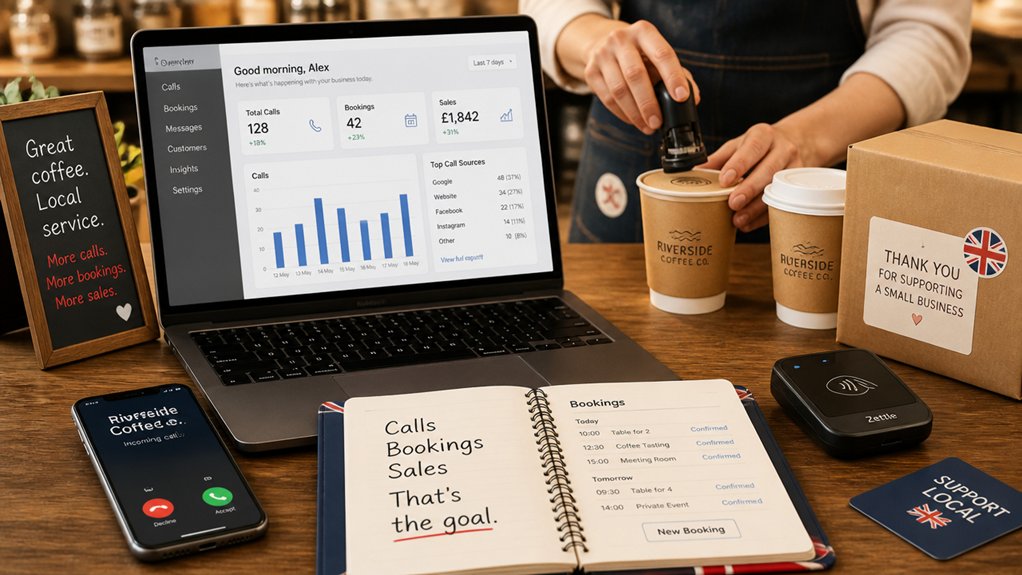
If you try to chase every metric at once, your content will usually end up doing nothing particularly well. Pick one outcome: calls, bookings, or sales, and build your Content strategy around it.
If you want calls, publish quick problem-solver posts with a clear phone CTA and track click-to-call rate.
If you want bookings, push a single service page, add a calendar link, and measure conversion rate by traffic source.
If you want sales, spotlight one offer, add proof, and watch add-to-basket and checkout completion.
Tight audience targeting makes this work: define who you’re speaking to, where they’re in the UK, and what triggers action.
Then choose one KPI, one CTA, and one landing path, and optimise weekly.
Use a 30-Minute Weekly Content Routine
Although consistency beats bursts of effort, you don’t need hours to stay visible—you need a repeatable 30-minute weekly routine.
Set a timer. Spend 10 minutes reviewing last week’s numbers: clicks, calls, bookings, or sales. Keep what moved your primary goal; drop what didn’t.
Next, use 10 minutes to draft three short posts: one proof point (result, testimonial, stat), one behind-the-scenes, one offer or reminder.
Then take 5 minutes for audience segmentation: tweak the same post for homeowners vs. landlords, or B2B vs. retail, so relevance stays high without extra work.
Use the final 5 minutes for Content scheduling across your channels for the week, and you’re done.
Repeat weekly; compounding beats perfection.
Turn Customer Questions Into FAQ Posts (Fast Wins)
When you turn the questions customers already ask into short FAQ posts, you get quick, high-intent content without brainstorming from scratch.
Pull queries from inboxes, live chat, call logs, and on-site search.
Then, pick the top 5 by volume or revenue impact.
Write each post to answer in under 200 words:
- State the question in the H1.
- Give the direct answer first.
- Then add one proof point (price range, delivery window, eligibility).
- Finish with a next step.
Use customer feedback to spot wording customers actually use, then mirror it for better match.
For FAQ optimization, add clear headings, internal links to relevant services, and structured data where appropriate.
Track clicks, time on page, and lead forms to prioritize updates.
Reuse Reviews as Social Posts and Website Snippets

You’re already sitting on high-converting content in your Google and Trustpilot reviews, so turn the best testimonials into quick social posts with a clear benefit and a real name or initial.
Then reuse those same lines as short quote snippets across key pages—homepage, service pages, and checkout—to reduce hesitation at the exact moment people decide.
Track clicks and conversions before and after so you can prove which quotes actually move the numbers.
Turn Testimonials Into Posts
Because prospects trust other customers more than they trust your sales copy, turning testimonials into posts gives you fast, credible content that actually moves the needle.
Start by pulling 10–20 recent reviews from Google, Trustpilot, or email replies, then run quick feedback analysis: tag themes like speed, quality, price, or support, and count what shows up most.
Turn each theme into a weekly post. Lead with the customer’s words, add one sentence of context (“Here’s how we delivered in 48 hours”), and end with a simple CTA to enquire or book.
Keep it compliant: get permission for named quotes, anonymise if needed, and don’t edit meaning.
Track saves, clicks, and DM volume. When you spotlight real outcomes, you reinforce customer loyalty and reduce sales friction.
Add Quote Snippets Sitewide
Even if you don’t have time to write fresh content every week, you can lift high-performing reviews into short quote snippets and place them across your site (and socials) to boost trust fast.
Put one on your homepage hero, product pages, pricing page, and key service pages—where buyers hesitate. Aim for specific outcomes (“cut turnaround by 30%”) rather than vague praise.
Rotate snippets monthly and A/B test placements; you’ll often see higher click-through and enquiry rates with proof near the CTA.
Repurpose the same quotes into LinkedIn, Instagram Stories, and Google Business Profile posts, keeping brand visuals consistent.
Use Content automation to pull fresh reviews from your CRM and publish them sitewide.
If you run Influencer collaborations, turn creator feedback into compliant, on-page quotes too.
Post Weekly Behind-the-Scenes From Real Jobs

One weekly behind-the-scenes post from a real job can outperform polished promos because it shows proof, not promises. You build trust fast when people see your process, tools, and standards on an actual UK site, not a stock photo.
Keep it repeatable: film a 20–40 second clip, add one caption on the job goal, and finish with the outcome. Track saves, comments, and profile clicks; these are stronger intent signals than likes.
Use Brand storytelling by framing the problem, constraints, and decision you made on-site. Add Employee highlights by naming who led the work and what they’re checking for (safety, finish quality, timing).
Post the same format every week so your audience learns what to expect, and you can compare performance week to week.
Share Quick How-To Tips Your Customers Can Save
Keep your content useful by sharing quick how-to tips customers can save and use on the spot—you’ll earn repeat views because practical posts get bookmarked.
Create bite-sized guides (think 60-second steps) and share printable checklists that make the next action obvious.
Then post before-and-after tips to show measurable improvements, so your advice feels proven rather than promotional.
Create Bite-Sized Guides
When your customers need an answer fast, bite-sized guides give them a practical fix they can save and use later. Keep each guide to one problem, one outcome, and 3–5 steps. That format performs well because it reduces cognitive load and boosts completion rates, especially on mobile.
Build them from real queries: your site search, support tickets, and “People Also Ask” results for UK terms. Then map topics to your content strategy and tighten audience targeting by tailoring examples to roles, locations, or industries you serve.
Publish as short posts, LinkedIn carousels, or 60–90 second videos with captions. Add a clear title, numbered steps, and one proof point (time saved, cost avoided, error reduced). Track saves, dwell time, and repeat visits to refine what you create.
Share Printable Checklists
To make Printable checklists work, pull steps from questions you already answer in calls and support tickets. Then prioritize the 5–10 actions that prevent errors. Add checkboxes, time estimates, and a “done” outcome so users can self-verify.
Track performance with download rate, email opt-ins, and repeat visits. Aim to improve each version monthly.
For content planning, batch-produce three checklists at once and reuse them across blogs, email, and LinkedIn posts.
Post Before-And-After Tips
Although you don’t need a big campaign to get results, before-and-after tips give you a fast, repeatable post format that people actually save and revisit.
Pick one common customer pain point, show the “before” mistake, then show the “after” fix in 3 steps. Keep each step under 12 words so it’s scannable on mobile.
Use Visual storytelling: one photo, one annotation, one result metric (time saved, cost reduced, fewer returns).
Add a simple CTA like “Save this for later” to lift audience engagement.
Batch five posts at once and publish weekly; track saves, shares, and profile clicks to prove what resonates.
If you can, add a mini case stat from a UK customer to build trust fast.
Create Before-and-After Posts That Prove Results
Because people trust proof more than promises, before-and-after posts let you show measurable results from your work instead of just talking about them.
Pick one clear metric: time saved, costs reduced, conversions lifted, waste cut, or ratings improved. Share the baseline, what you changed, and the outcome, all in one swipe or carousel for strong Visual storytelling.
Keep it tight: “Before: 2.1% checkout conversion. After: 3.4% in 30 days.” Add a screenshot, chart, or photo evidence, and mention tools used.
Anticipate objections by stating sample size, timeframe, and any constraints.
End with a question that invites replies (“Which step would you try first?”) to boost audience engagement.
Repurpose the same proof into a short video, email, and case-study snippet too.
Write Local UK Posts for Your Town and Service Areas
Mine your data: enquiries by postcode, top routes, and seasonal demand. Turn that into helpful guides like “Boiler servicing in Leeds LS6: what it costs and what’s included” or “Office cleaning in Croydon: after-hours options.”
Build community engagement with local event roundups, and win backlinks through local collaborations with charities, gyms, or builders.
Use Google Business Profile Posts to Stay Visible
When you post regularly on your Google Business Profile, you give Google fresh signals and you stay in front of people who are already searching in your area. Treat Posts like mini-ads: one clear offer, one photo, one call to action (Call, Book, or Learn more). Aim for 1–2 posts a week so your listing doesn’t look stale.
Use Posts to reinforce Local branding: show your team, highlight a popular service, or share a quick before-and-after. Keep copy under 150–200 characters, lead with the benefit, and add a tracked link (UTM) so you can measure clicks in GA4.
Watch Insights for views, calls, and direction requests, then repeat what lifts Customer engagement.
Create Seasonal UK Content (Bank Holidays, Weather, Events)
You’ll get faster engagement when you plan content around UK bank holidays, local events, and the week’s weather—topics people are already searching for.
Build a simple bank-holiday content calendar (offers, opening hours, reminders) and plug in event hooks like festivals, school terms, and match days.
Then use weather triggers (heatwave, cold snap, rain) to switch up your messaging and products in real time.
Bank Holidays Content Calendar
Eight UK bank holidays (plus key seasonal moments like half-term, heatwaves, and major sporting events) give you predictable spikes in attention—so build a simple content calendar around them.
Map each date to three beats: pre-holiday (7–10 days out), peak weekend, and post-holiday follow-up.
Pre-holiday, run “planning” posts and email reminders; at peak, push Holiday promotions with clear cut-offs (delivery, bookings, opening hours); after, share results, reviews, and next-step offers.
Keep Seasonal themes consistent: spring refresh, summer getaways, autumn back-to-routine, winter gifting.
Track baseline vs holiday-week lift in site traffic, enquiries, and revenue, then reuse what performs.
Batch-create templates (social captions, hero banners, landing pages) so you only swap dates and offers.
Weather And Events Hooks
Pair this with Event planning. Create templates for match days, Pride weekends, Christmas markets, and exam season: one blog, three socials, one email.
Track performance by comparing CTR and conversions against your baseline weeks. If a hook lifts results, add it to your seasonal playbook.
Keep Short Videos Simple (One Tip, One Clip)
Because attention spans drop fast on social feeds, keep your short videos to one clear tip in one focused clip. Pick a single problem you can solve in under 20 seconds, then script it as: hook, tip, proof, next step.
Treat video length like a KPI: if viewers drop at 3–5 seconds, tighten the opening and remove any setup. Prioritise visual simplicity: one location, one subject, clear captions, and one on-screen prop or screenshot. Avoid jumpy edits unless they add meaning.
Use a strong first frame (result first), then show the how. End with one specific CTA, like “Download the checklist” or “Book a 10‑minute call,” and track taps, watch time, and saves.
Repurpose One Idea Into 5 Posts Across Channels
When you’re short on time but still need consistent reach, repurpose one strong idea into five platform‑native posts instead of forcing yourself to invent five new topics. Pick a single insight from sales calls, FAQs, or reviews, then slice it into formats people actually consume.
Turn it into: a LinkedIn carousel with 3 stats, an Instagram Reel showing the “before/after,” a TikTok with one myth-busting hook, an email tip with one clear CTA, and a short blog post that ranks for a local-intent keyword.
This Content diversification boosts distribution without bloating your workload. Track saves, click-throughs, and replies per channel to see what drives audience engagement, then double down next week.
Keep the core message consistent, but tailor the opening line, visuals, and length to each platform.
Co-Create Content With Local Partners (Cross-Promotions)
Repurposing stretches one idea across channels, but partnering locally stretches your reach across audiences you don’t own yet.
Pick one complementary business (gym + physio, café + florist, accountant + solicitor) and plan a simple local collaboration: one joint reel, one carousel, and one email swap.
Keep it mutually useful—shared tips, a mini case study, or a “day in the neighbourhood” guide.
Make the brand partnership easy to say yes to. Draft the hook, outline, and posting dates, then let your partner add their angle.
Use consistent visuals, tag locations, and agree on one shared hashtag.
Cross-promotions work because you borrow trust: people follow recommendations from businesses they already use.
Track What Brings Enquiries (Calls, Forms, DMs)
If you don’t track where enquiries come from, you can’t know which content actually pays off.
Set up simple attribution so calls, form fills, and DMs get tied back to the channel or post that triggered them.
Then measure the volume and quality of each enquiry type, and double down on what consistently converts.
Attribute Enquiries To Channels
How do you know which content actually drives enquiries, not just clicks? You won’t unless you tie each enquiry back to a source with simple, consistent tracking.
Start by tagging every campaign link with UTM parameters (source, medium, campaign), then keep your naming tight so reporting doesn’t fragment. In your CRM or spreadsheet, add a required “how did you hear about us?” field and standardise the options to match your UTMs.
Now you can run channel analysis that shows which channels generate real leads, not vanity traffic. For enquiry attribution, pick a rule and stick to it (first touch, last touch, or split credit) so month-to-month comparisons stay fair.
Review weekly, then double down on what converts and cut the rest.
Measure Calls, Forms, DMs
Because enquiries don’t all arrive through a neat web form, you need tracking that captures calls, contact forms, and social DMs in the same reporting view.
Start by setting up call tracking numbers per campaign or landing page, then pipe form submissions into your CRM with source/medium fields.
For DMs, use tracked links (UTMs) in posts and stories, and log conversations as leads with a consistent naming rule.
Next, build simple lead attribution: first touch, last touch, and “qualified” touch (the content that triggered the enquiry).
Review weekly: volume, conversion rate, and revenue per channel.
If calls spike after a how-to video, double down.
If DMs convert poorly, tighten your offer and response time.
Conclusion
If you keep your content tied to one clear goal—calls, bookings, or sales—you’ll stop guessing and start seeing results. Stick to a 30-minute weekly routine, turn real questions into quick FAQs, and reuse reviews and job photos to build trust. Keep videos simple, then repurpose one idea across five channels. Partner locally to widen reach. Track enquiries like a compass: calls, forms, and DMs tell you what’s working—and what to drop.