


You’ll get more sales from social media in the UK by setting one clear goal (leads, ecommerce revenue, booked calls) and tracking revenue-linked KPIs like CPA, conversion rate, and AOV using UTMs and promo codes. Focus on platforms where buyers already are (Meta, TikTok Shop, Instagram Shopping, Google Business Profile), then build a trackable funnel: pinned offer → single DM CTA → checkout. Post problem/solution Reels, proof carousels, and offer-led Stories weekly, then retarget and optimise every Monday. Keep going for the exact funnel and tests.
Key Takeaways
- Set revenue-first goals and track KPIs like cost per lead, conversion rate, and revenue per follower using UTMs, promo codes, and CRM attribution.
- Prioritise high-intent channels UK buyers use, such as Meta, TikTok Shop, Instagram Shopping, Search ads, and Google Business Profile.
- Publish a conversion-focused content mix: problem/solution Reels, proof carousels, offer-led posts, FAQ Stories, and founder demos with clear CTAs.
- Build a simple funnel with one pinned offer, trackable links, and a single DM keyword CTA to move prospects from interest to purchase.
- Scale with paid retargeting, capped frequency, weekly creative tests, and incremental budget increases (+20%) based on CPA and conversion lift.
Choose Your UK Social Sales Goal (and KPI)

Before you post another campaign on LinkedIn, Instagram, or TikTok, decide what “social sales” needs to deliver for your UK business and how you’ll measure it.
Pick one primary goal: qualified leads, ecommerce revenue, booked calls, or repeat purchases.
Then assign a single KPI that ties to cash: cost per lead, conversion rate, average order value, or revenue per follower.
Set a baseline from the last 30 days, and target a realistic lift (e.g., +15% in 8 weeks).
Track with UTM links, promo codes, and CRM attribution so you don’t guess.
If you run Influencer collaborations, measure incremental revenue per creator, not likes.
If you use Customer testimonials, measure assisted conversions and time-to-close.
Review weekly, cut losers fast, focus on the growth results.
Pick the Best Platforms for UK Customers
Pick platforms based on where your UK customers already spend time and how they prefer to buy, not on what’s trending.
Use your audience data (age, location, interests, device, and referral sources) to match channels to segments.
Then focus budget on high-intent platforms that reliably drive clicks, leads, or purchases.
You’ll cut wasted spend and scale the networks that convert.
Match Platforms To UK Audiences
Although most UK consumers use more than one social app, you’ll get better ROI by matching each platform to the specific UK audience segment you want to reach—then aligning your content format and targeting to how they actually behave there.
Start with Audience segmentation: define age, life stage, region, interests, and buying context, then map each segment to the platform where it’s most active.
Use Meta for broad local reach and community signals; use Instagram for visual discovery and creator-style proof; use TikTok to reach younger, trend-led buyers with short demos; use LinkedIn for decision-makers with expertise-led posts; use Pinterest for planners searching seasonal ideas.
Apply Content personalization by swapping creatives, hooks, and offers per segment, then A/B test formats, captions, and placements weekly.
Track reach, saves, shares, and click-through by segment, not averages.
Prioritise High-Intent Channels
Segment-to-platform mapping gets you in front of the right UK audience, but the next step is putting your budget where buying intent shows up. Prioritise channels that shorten the path to checkout: Google Business Profile and Search ads for “near me” demand, Meta for retargeting and lead forms, and TikTok Shop or Instagram Shopping for impulse-friendly products.
Track cost per qualified lead, add-to-cart rate, and ROAS by platform weekly, then reallocate spend fast. Use influencer collaborations when you need trust and product demonstration; negotiate trackable links and UK-only codes to prove lift.
Keep Brand storytelling tight: one problem, one proof point, one offer. If a platform can’t drive measurable action in 30 days, pause it.
Build a Social Media Funnel: Offer → DM → Checkout
If you want your social media to generate predictable revenue (not just likes), build a simple funnel that moves people from a clear offer to a DM conversation and then straight to checkout.
Lead with one measurable offer (e.g., “£49 trial”, “free audit”, “book a fitting”) and pin it across profiles. Use trackable links, unique codes, and UTM tags so you can see DM-to-sale conversion by channel.
Next, push prospects into DMs with a single CTA: “Message ‘QUOTE’ for options.” Set up quick replies to qualify (budget, postcode, timeline) and send the right payment link or booking page within 2 minutes.
Add social proof screenshots. Test Influencer collaborations and viral challenges only if they drive DM volume and checkout rate, not reach.
Post Content That Sells: 5 Formats + Weekly Cadence
When you post with a sales objective, your content should move prospects one step closer to a DM or a checkout, not just rack up views.
Prioritise five formats:
(1) problem/solution Reels showing outcomes
(2) customer proof carousels with numbers
(3) offer posts with a clear “DM keyword” CTA
(4) FAQ Stories with polls, then “Reply for link”
(5) founder-led live demo/behind-the-scenes to reduce risk.
Run a simple weekly cadence: 2 Reels, 2 carousels, 3–5 Stories, 1 live.
Track saves, DM starts, and link clicks; double down on posts that drive DMs per 1,000 views.
Use content repurposing: cut live clips into Reels and turn FAQs into carousels.
Add influencer collaborations focused on testimonials, not reach.
Scale With Paid Social: Retargeting, Budgets, Creatives
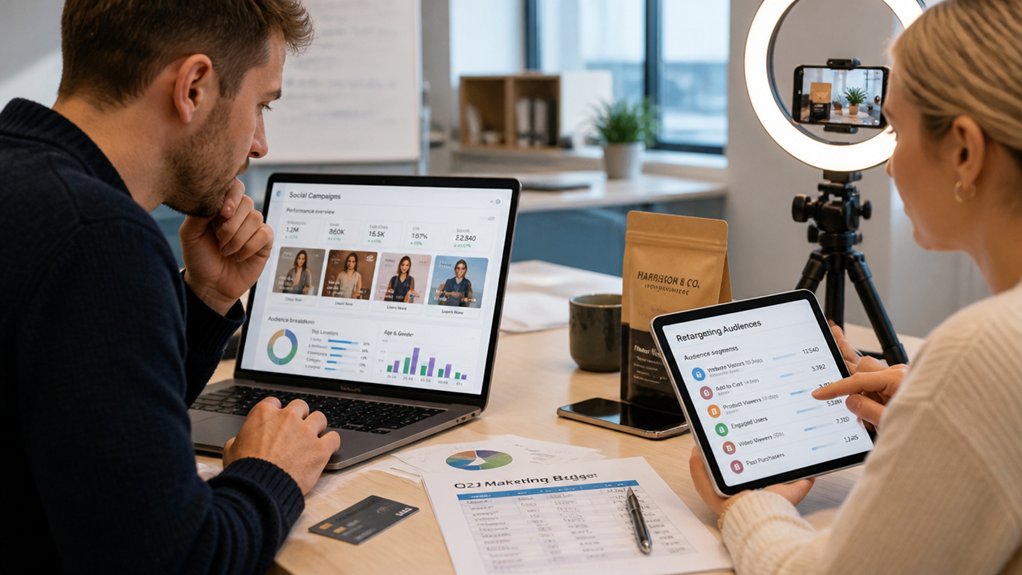
Once your organic cadence’s working, you scale faster with paid social by building a retargeting funnel that moves warm audiences from awareness to conversion with clear audience windows and frequency caps.
You’ll set budgets and bidding around measurable targets (CPA, ROAS) and shift spend to the ad sets that hit your benchmarks, not the ones that “feel” right.
Then you’ll test high-performing creatives systematically—strong hooks, UK-relevant proof, and clear CTAs—so your winners earn more budget and your losers get cut fast.
Retargeting Funnel Strategy
A high-performing retargeting funnel usually needs three layers: warm (site visitors), hotter (product/service page viewers), and hottest (cart/checkout or lead-form starters).
Build audience segmentation around intent and recency (e.g., 1–3, 4–14, 15–30 days) so you match urgency to message. Exclude recent buyers and converters to stop waste and protect frequency.
Use retargeting tactics that escalate value: warm gets proof (reviews, press, UGC) and a clear benefit; hotter gets product comparisons, FAQs, and objection-handling; hottest gets urgency, risk reversal, and a direct CTA (book, buy, call).
Rotate creatives every 7–14 days, A/B test hooks and offers, and track view-through and click-through conversions to spot lift without double-counting.
Budgeting And Bidding
How much should you actually spend on retargeting without burning budget on people who won’t convert? Start by setting Budget allocation by intent tiers: 60% to high-intent (cart/lead form), 30% to mid-intent (product viewers), 10% to low-intent (engagers).
Cap frequency at 2–3/day and 8–10/week, then watch CPA and incremental lift, not clicks.
Choose Bid strategies that match your data. If you’ve got 50+ conversions/week, use cost cap to stabilise CPA; if not, use lowest cost with a firm daily budget and strict exclusions.
Raise budgets by 15–20% every 48 hours when CPA stays within target.
Pause segments that hit 1.5x target CPA after 1,000 impressions.
High-Performing Paid Creatives
Because retargeting audiences are small and see your ads repeatedly, your creative has to do the heavy lifting: stop the scroll fast, answer the “why buy now?” objection, and make the next step frictionless.
Build 3–5 variants per offer and rotate weekly to prevent fatigue; watch frequency and CTR to spot drop-offs.
Use audience segmentation: cart abandoners get urgency and reassurance, product viewers get benefits and social proof, past buyers get upgrades or bundles.
Lead with creative storytelling that shows the before/after in the first 2 seconds, then overlay one clear value prop and a single CTA.
Test formats (UGC, founder demo, carousel) with fixed budgets, and kill losers fast using CPA and holdout uplift.
Keep landing pages consistent.
Track Social Media Sales and Optimise Every Week
While you can’t improve what you don’t measure, you can track social media sales in the UK with a simple weekly rhythm: tag every link with UTM parameters, set up conversion tracking in GA4 (and the Meta/TikTok/LinkedIn pixels where relevant), then review a tight set of KPIs—revenue, cost per acquisition, conversion rate, and assisted conversions—every Monday.
Next, break results by channel, campaign, and creative. If influencer collaborations drive high assisted conversions but weak last-click revenue, tighten landing pages and add offer-led CTAs. If viral campaigns spike clicks but tank conversion rate, cap spend, refresh targeting, and test shorter hooks.
Run two A/B tests weekly: one creative, one landing element. Pause losers fast, scale winners with +20% budget steps, and document learnings in a simple sheet so you don’t repeat mistakes.
Conclusion
Now you’ve got a practical plan to turn social into sales. Set a single UK-focused goal and KPI, pick platforms where your customers already click, and build a simple funnel from offer to DM to checkout. Post five proven formats on a consistent cadence, then scale with smart spend: retarget warm audiences, test creatives, and cap budgets by CPA. Track clicks, conversations, and conversions weekly—then tweak, trim, and double down.