


Start by validating demand with real signals: build a one-page offer with a price, drive £50–£200 of targeted traffic, and track sign-ups, conversions, and drop-offs. Research 5–10 UK competitors to spot gaps you can win. Write a one-page plan and 12‑month cash forecast, then pick a structure (sole trader, partnership, or limited company) and register with HMRC or Companies House. Set up tax basics, insurance, licences, and bookkeeping before your first sales. Keep going to see the full checklist.
Key Takeaways
- Validate demand with market research, a one-page offer site, and £50–£200 test ads tracking sign-ups, conversions, and pre-orders.
- Write a one-page business plan and cash forecast covering pricing, acquisition costs, VAT timing, setup spend, burn rate, and scenarios.
- Analyse 5–10 UK competitors to find gaps in pricing, delivery, trust signals, and niche positioning you can defend.
- Choose a legal structure and register correctly: Companies House for limited companies, HMRC for sole traders, then set up UTR, Corporation Tax, PAYE, VAT.
- Open a business bank account and confirm insurance, licences, and local council compliance for your activities, premises, signage, waste, fire safety, and rates.
Validate Demand for Your Idea in the UK

Before you spend money on branding or inventory, prove there’s real UK demand for your idea with evidence, not gut feel. Start with Market research: check Google Trends for UK searches, scan Amazon and Etsy best-seller ranks, and use ONS or industry reports to confirm the problem exists and is growing.
Estimate willingness to pay by collecting real signals, not likes.
Next, run a lean test. Build a one-page site with a clear offer and price, then drive small traffic via £50–£200 in UK-targeted ads or relevant forums. Track conversion rate, email sign-ups, and drop-off points.
Finally, get customer feedback through short calls, surveys, or pre-orders. If people commit time or money, you’ve validated demand.
Size Up UK Competitors and Your Niche
Once you’ve seen real UK demand signals, check what you’re up against and where you can win.
Start with Market analysis: list the top 5–10 UK competitors, their pricing, delivery times, trust signals (reviews, accreditations), and how they acquire customers (SEO ads, marketplaces, partnerships). Use Google, Amazon, Etsy, Checkatrade, and Trustpilot to capture patterns fast.
Then map gaps: underserved locations, slow response times, confusing offers, or poor customer support. Look for niches where you can specialise—specific customer type, use case, or compliance need—without shrinking the market too far.
Define your Competitive strategy in one line: what you’ll do better, for whom, and why it’s defensible. Sanity-check by comparing features, margins, and switching costs.
Build a Simple Plan and Cash Budget
How do you turn a good niche idea into something banks, investors, and your own sanity can trust? You write a one-page plan and a 12-month cash budget.
Start with your offer, price, and measurable goals: leads per week, conversion rate, average order value, repeat rate. Use market research to justify demand and assumptions, not opinions.
Define customer targeting clearly: who buys, why now, where you’ll reach them, and what it costs per acquisition.
Build a simple cash forecast: opening cash, sales in, VAT timing if relevant, fixed costs, variable costs, and one-off setup spend.
Stress-test it with best/base/worst cases, and track burn rate and runway. Update monthly using actuals and adjust fast.
Pick a Structure: Sole Trader, Limited, Partnership

Next, you’ll pick a legal structure—sole trader, limited company, or partnership—and it’ll shape your admin workload, tax bill, and personal risk.
You should compare how each option treats profits (Income Tax and NICs vs Corporation Tax) and what you can claim as expenses.
You’ll also need to weigh liability: sole traders and many partners can be personally on the hook for debts, while a limited company can ring-fence risk if you run it properly.
Compare Legal Structures
Where should you start when choosing a legal structure for your UK business? Start with how you’ll operate day to day: number of owners, need for external funding, and how formal you want your setup to be.
A sole trader suits one-person operations with fast decisions and minimal admin.
A partnership fits two or more owners sharing management, with a written agreement to set roles, profit splits, and exit terms.
A limited company works when you want a distinct business entity, clearer governance, and credibility with suppliers and lenders.
Compare ongoing obligations: registrations, record-keeping, confirmation statements, and contracts.
Prioritise Legal compliance by mapping required filings and policies to your capacity.
Protect Intellectual property early; company ownership and partnership terms change who controls IP and licensing.
Tax And Liability Differences
Once you’ve narrowed down a workable legal structure, you need to sanity-check it against tax and personal risk, because the differences affect your take-home pay and what’s on the line if things go wrong.
As a sole trader, you’re taxed through Self Assessment, and profits are yours, but you’re personally liable for business debts.
Pick a limited company if you want stronger liability management: the company owes the debts, not you (unless you give personal guarantees). You’ll pay Corporation Tax on profits, then take money out via salary and dividends, which enables practical tax planning if profits rise.
Partnerships split profits and tax across partners, but general partners can still face joint liability. Match the structure to your risk level, profit expectations, and borrowing needs.
Register With Companies House or HMRC
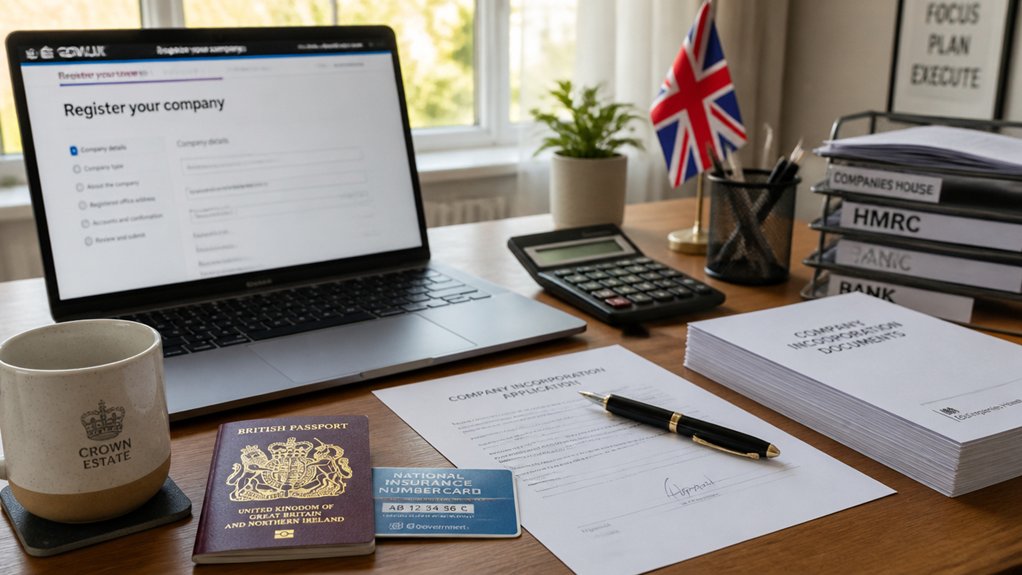
Once you’ve chosen your business structure, you need to register with the right body to trade legally and stay compliant.
If you’re forming a limited company, you’ll register with Companies House.
If you’re a sole trader or partnership, you’ll notify HMRC.
Do this early so you can set up your tax records, get the right references, and avoid penalties for late registration.
Choose Business Structure
Three main business structures cover most UK startups: sole trader, limited company, and partnership—and your choice dictates whether you register with HMRC (sole trader/partnership) or Companies House (limited company).
It also affects how much tax you’ll pay, and how personally exposed you’re if the business runs into debt. Use your market research to estimate revenue, costs, and risk: higher liability or outside funding usually pushes you toward a limited company.
Low-risk, solo work often fits sole trader. Sole traders keep admin light, but you’re personally on the hook for debts.
Partnerships share profits and responsibility, so get terms agreed early. Limited companies ring‑fence personal assets, but add reporting.
Match the structure to your pricing and branding strategy, not just today’s income.
Register With Companies House
After you’ve picked a structure, make it official by registering with the right body: limited companies incorporate at Companies House, while sole traders and most partnerships register with HMRC for Self Assessment.
For a company, file online, choose a unique name, set a registered office address, appoint directors, and issue shares if relevant. Keep your details consistent with your market research and branding strategies—your name and SIC code should match what you actually sell.
Companies House gives you a Companies Registration Number and publishes key facts on the public register, so double-check spelling, dates, and addresses before submitting.
Use the confirmation to open a business bank account, sign supplier contracts, and set up invoicing systems.
If you’re not incorporating, record your trading name and keep proof of registration for lenders.
Notify HMRC For Tax
Even if you’ve registered with Companies House, you still need to tell HMRC how you’ll be taxed, because incorporation doesn’t automatically set up Corporation Tax, PAYE, or VAT.
Register for Corporation Tax within 3 months of starting to trade (e.g., selling, buying stock, advertising, or hiring). You’ll need your UTR, company number, and the date you began trading.
If you’ll pay anyone through payroll, set up PAYE before the first payday, even for directors.
If your taxable turnover is likely to exceed the VAT threshold (£90,000), register promptly; late registration triggers backdated VAT and penalties.
Keep records for at least 6 years to support Tax compliance.
Make HMRC notifications early to reduce interest, fines, and admin churn.
Set Up Tax Basics: UTR, VAT, PAYE, CIS
Because HMRC won’t recognise your business until you’re registered in the right places, set up your tax basics early: get a Unique Taxpayer Reference (UTR) so you can file returns, register for VAT if your taxable turnover hits (or you expect to hit) the registration threshold, set up PAYE before you pay any employees, and register for CIS if you work as a contractor or subcontractor in construction so deductions and verification don’t stall payments.
Treat this as core Tax registration, not admin. Track monthly sales and forecast the next 12 months as part of Financial planning so you don’t miss VAT timing. If you’re near the threshold, decide whether voluntary VAT registration helps your pricing or cashflow.
For PAYE, gather starter details, choose payroll software, and confirm RTI reporting works.
For CIS, verify subcontractors early and keep deduction records tight.
Open a Business Bank Account (What You’ll Need)
To open a UK business bank account, you’ll need valid ID (typically a passport or driving licence) plus proof of address.
You’ll also need business details and evidence such as your company number or UTR, your trading name, and invoices or contracts that show you’re operating.
Then you’ll compare banks on fees, transaction limits, online tools, and approval times so you pick an account that fits how you’ll get paid and spend.
Required Identification Documents
Before you walk into a branch or start an online application, get your ID documents lined up—UK banks won’t open a business account until they’ve passed “Know Your Customer” and anti–money laundering checks.
For Identification verification, you’ll typically need one government-issued photo ID: UK passport, UK driving licence, or EEA passport/ID card.
If you don’t have photo ID, some banks accept a biometric residence permit or UK residence card, but rules vary.
Plan for document submission through an app or in-branch scan. Make sure images are sharp, full-frame, and unedited; glare, cropped corners, or expired IDs often trigger rejection.
If you’re not a UK resident, expect extra checks and longer review times. Keep originals available in case the bank requests a live verification call.
Business Details And Proof
With your ID checks sorted, the bank will then ask for business details that prove what you do and who really controls the company. Expect to share your Companies House number (or UTR if you’re a sole trader), trading address, website, and a short description of products and customers.
You’ll also confirm beneficial owners and directors, plus source of funds if you’re injecting capital.
Bring evidence: invoices, signed contracts, purchase orders, or platform statements that show real trading. If you’re pre‑revenue, use a business plan backed by market research—target customers, pricing, and projected volumes.
Add business branding assets (domain, logo files, marketing materials) to show you’re operational. Keep digital copies ready; many banks reject unclear PDFs or mismatched addresses.
Choosing The Right Bank
Although most UK business accounts look similar on the surface, the right bank comes down to measurable fit—fees, cashflow tools, and how fast you can pass onboarding.
Start by pricing your usage: monthly fees, card charges, cash deposits, and international payments. If you invoice or take card payments, compare integrations, payout times, and limits inside online banking.
Check FSCS protection rules and whether you need a traditional bank or an e-money provider.
To open the account, you’ll typically need proof of identity (passport/driving licence), proof of address, your company registration number (or UTR if you’re a sole trader), and details of directors/PSCs.
Have your trading address, expected turnover, and nature of business ready.
Choosing the right bank reduces admin and payment delays.
Get UK Insurance That Fits Your Risks
Since one uninsured claim can wipe out months of cash flow, you should match your UK insurance to the specific risks your business actually faces—not a generic bundle.
Start with a simple Risk assessment: what could realistically happen, how often, and what it’d cost to fix. Use your numbers: average job value, stock on hand, daily revenue, and worst-case downtime.
Then compare Insurance options that map to those exposures. If you meet clients or work on-site, public liability often matters most. If you give advice, consider professional indemnity. If you store equipment or stock, contents and business interruption can protect turnover. If you hire anyone, employers’ liability is typically required.
Get quotes from two or three brokers, and don’t underinsure limits.
Check Licences, Permits, and Council Rules
Before you trade a single day of revenue for a compliance headache, check which UK licences, permits, and council rules apply to what you actually do and where you do it. Start with GOV.UK licence finder and your council’s business pages, then confirm in writing if anything’s unclear.
Match your activities to Licensing requirements: alcohol sales, late-night refreshment, food premises registration, street trading, waste carrier registration, or regulated services.
Next, map Local council regulations that affect your premises and operations: planning use class, signage consent, pavement licences, noise limits, fire safety, and business rates.
If you’re home-based, check restrictive covenants, landlord clauses, and neighbour nuisance rules.
Build lead time into your launch; some approvals take weeks, and enforcement can shut you down fast.
Set Up Bookkeeping, Records, and Accounting Tools
Once you’ve confirmed the licences and council rules you need, set up your bookkeeping so every sale, cost, and tax point lands in the right place from day one.
Pick cloud accounting software that supports UK VAT, bank feeds, and HMRC-friendly reports.
Create a chart of accounts that matches how you’ll track revenue streams and main cost lines.
Separate business and personal money with a dedicated bank account and card.
Lock in Bookkeeping essentials: daily transaction capture, weekly bank reconciliation, and monthly review of cash flow and liabilities.
Use record keeping strategies that stand up to audits: store digital copies of invoices and receipts, label expenses consistently, and keep mileage and petty cash logs.
Set reminders for VAT, PAYE, and Corporation Tax dates, and back up data automatically.
Get Ready to Trade: Pricing, Contracts, First Sales
Although your product or service may be ready, you won’t trade smoothly until you lock in pricing, put simple contracts in place, and build a repeatable way to win your first sales.
Start with Pricing strategies: calculate your unit cost, then set a target gross margin and a walk-away price. Test price points with 10–20 prospects, track conversion rate, and adjust based on demand, not guesswork. Offer two to three packages so buyers can self-select.
Next, standardise terms before you chase revenue. Use short proposals, clear scope, payment terms, late fees, and IP ownership.
In Contract negotiations, trade concessions, don’t give them away: change price, timelines, or scope together.
Finally, build a pipeline: list 50 leads, run weekly outreach, log replies, and aim for your first three paid customers.
Conclusion
You’ve pressure-tested demand, scoped competitors, built a lean budget, and chosen the right UK structure. You’ve registered with HMRC or Companies House, covered key risks with insurance, and checked licences and council rules. Your records and tools are in place, so numbers won’t lie. Now it’s execution: set pricing, use clear contracts, and chase first sales. Like Odysseus, you don’t need a perfect map—just bearings, discipline, and steady progress.